
It has been a successful week for William Buick. On Tuesday he won the King’s Stand on Blue Point, and on Friday he rode Old Persian to victory in the King Edward VII Stakes. Earlier this month, Buick gave Charlie Appleby his first Epsom Derby win with Masar…
Xander Brett
William Buick is one of Britain’s star jockeys. That he’s an extraordinary rider, everyone knows. Of the fact he grew up in Norway, few are aware. Buick’s mother, Maria, was a dressage rider. His father, Walter, was Scandinavian champion jockey eight times. Buick rode out every morning before school, spending summer holidays in the UK, at the yards of Marcus Tregoning, Reg Hollinshed and Andrew Balding. As soon as he could, he left secondary education, joining Balding’s yard full-time.
August 2006 was the first time we saw Buick, aged eighteen, on the track. He had his first win a month later (aboard Bank On Benny at Salisbury). Before 2006 was out, Buick had ten wins under his belt. In 2008, he was joint champion apprentice. Over the next nine years, Buick would go on to take a Queen Anne, a St Leger, an Irish Derby and an Irish Oaks. Surely, with such passion, he was destined to leave Scandinavia as soon as he could. Norway has just one flat racecourse.
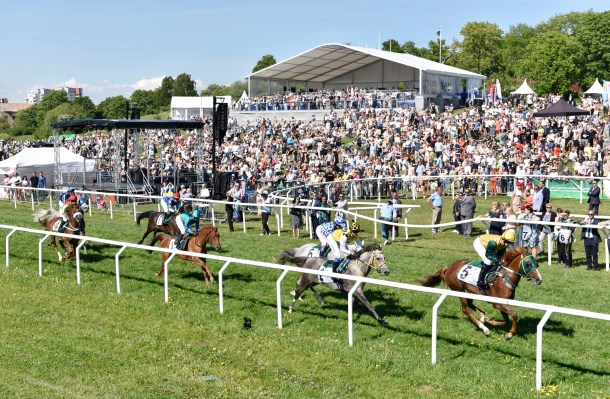
Crowds at Sweden’s Nationaldagsgaloppen (Photo: Stefan Olsson/Svensk Galopp)
Feature image: Øvrevoll Galoppbane
Norwegian racing is a niche world. Too niche, certainly, for Buick. But Scandinavian racing more generally is a niche that holds its own. Denmark, Norway and Sweden all have their own racing authorities, and all three their own Derby: Denmark’s is held at Klampenborg, in northern Copenhagen, Norway’s at Øvrevoll in Oslo, and Sweden’s (on dirt) at Jägersro, in the suburbs of Malmö. In fact, racing in Denmark goes as far back as 1770, when Caroline Mathilde, an English princess married off to Christian VII of Denmark (her first cousin) arranged small, exclusive, race meetings near Copenhagen. Soon after, following what Nick Elsass, chairman of the Dansk Galop, calls “a minor Danish revolution”, they were abandoned. To bear children (not easy with your first cousin) Caroline Mathilde had continued an affair with the king’s physician, Johann Friedrich Struensee. As Struensee overtook King Christian as de facto ruler, the court decided to execute him and exile Caroline to Hanover.
Successive monarchs showed little interest in carrying on her passion, and there was thus a gap in meetings for well over fifty years. Finally, in the late 1820s, racing was held again at Nørre Fælled in the centre of the capital. In 1870, it moved out of town to Jægersobrg Dyrehave, where the present-day Klampenborg racecourse was inaugurated in 1910. Danish racing also shares three courses with trotting: one in Aarhus, one in Odense, and one in Aalborg. Competition arrives from all over Scandinavia, though the Dansk Derby, says Nick Elsass, is restricted to horses foaled in Norway, Sweden or Denmark. Though Queen Margarethe is the course’s patron, Elsass describes Klampenborg’s meetings as casual. “There’s no formal dress code,” he explains, “though people dress up a bit for Lady’s Day in September.”
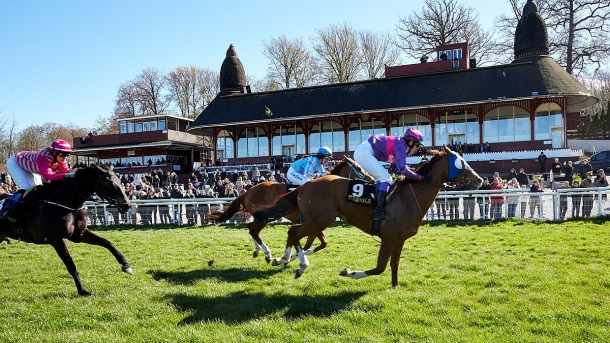
Photo: Klampenborg Galopbane
“There’s no formal dress code,” says Dansk Galop chairman, Nick Elsass, “though people dress up a bit for Lady’s Day in September.”
Before it closed in 2016, Stockholm’s Täby racecourse was a leading European racecourse, holding up to fifty meetings a year. Täby’s meetings have now been moved to Bro Park, a state-of-the-art new base with training facilities about forty kilometres north of the Swedish capital.
The Svenskt Grand National, held at Strömsholm, near Västerås, attracts an audience of over 4,000 each year. Winners of the G3 Stockholm Cup, meanwhile, include Collier Hill and Labirinto. There’s also a turf-only racecourse at Gothenburg. And, to the delight of thousands, the traditional ‘Nationaldagsgaloppen’, held annually at a temporary circuit in Gärdet park, central Stockholm, remains a permanent calendar fixture.

Photo: Svensk Galopp
One Danish official summed up the state of Scandinavian racing when they said “the Norwegians have the money, the Swedes the races and the Danes the jockeys.” Sweden’s races are increasingly respected, and Norway has both good sponsors and ambitious owners. Danish racing, too, has produced some top riders.
But William Buick sits above them all. Now firmly based in Newmarket, while Buick may not be propping up the Scandinavian racing scene, he certainly owes it a great deal of thanks.
Bonus: Swedish Jockey Ulrika Holmquist in Conversation
Firstly, could you tell us about your childhood… where did you grow up, and was it around horses and/or racing?
I grew up in Gothenburg. My family wasn’t really racing or horse orientated at the time, but they soon became so, given my interest. I did show jumping and eventing as a junior rider, and a bit of pony racing. Then, when I was 17, I was introduced to racehorses.
To what extent was racing in Sweden a ‘man’s world’ when you entered it. And have things changed?
We have a good proportion of female jockeys in Sweden, but there’s still a dominant proportion of men in the bigger and more valuable races. Still, the chances girls get in relation to their performance and talent seems to be increasingly level, in the same way as a lot of other roles in society.
The world was delighted to see Hollie Doyle’s recent success in the Prix de Diane… Do you communicate with her, and with female jockeys from all over the world?
Yes, I’m lucky to have met and ridden with Hollie on a few occasions. She’s a fantastic rider, and a fantastic human being, as well as being an inspiration for other jockeys. What she achieved in France is really ground-breaking for us female jockeys: being one of the first females (since Hayley Turner) to take a leading role as a rider in Europe. She works very hard and deserves the success she gets.
You’ve been riding in New Zealand recently. Could you tell us about the experience, and where else you’ve raced around the globe?
I did the majority of my apprenticeship ‘down under’, before moving back to Sweden. Racing is big in New Zealand, and both the horses and racing hold a very high standard, given it’s such a small country. I enjoyed my apprenticeship, and learned so much more then I would’ve done had I just stayed in Europe. I’ve also ridden in the UK, USA, UAE, Spain and Saudi Arabia… outside the Scandinavian countries, of course.
I saw you recently on Gärdet for the Nationaldagsgaloppen. What was the atmosphere like that day (particularly after two years without the event). And what’s it like to race at Sweden’s other courses?
It was great to be back at Gärdet, with 42,000 people cheering you all the way round. It’s a special feeling to ride on a racecourse that’s set up in the middle of the city. The other courses are permanent, and I’m based at Bro Park, which is outside Stockholm and must be one of the newest racecourses in the world, as it only opened in 2016.
Racing in Scandinavia is informal… do you think there’s enough glamour?!
Well, fashion is important to me… and probably something I spend more money and time on than I should! I think racing is fun, in contrary to the trotting that dominates equestrian sport here. We certainly have more glamour and flair around ‘straight’ racing, but Scandinavian racing is nowhere near as large as meetings such as Royal Ascot, with ITV and international coverage, and 300,000 spectators across the week.
Extracts of this article have also been published in Nordic Style Magazine.
 Fika
Fika 